
Athelguard / Technology due diligence
Case Studies
A clear claim. A testable evidence trail. A decision tied to what the technology can actually deliver.
01 / Wireless power
Wichargless
The submitted configuration did not support the advertised output
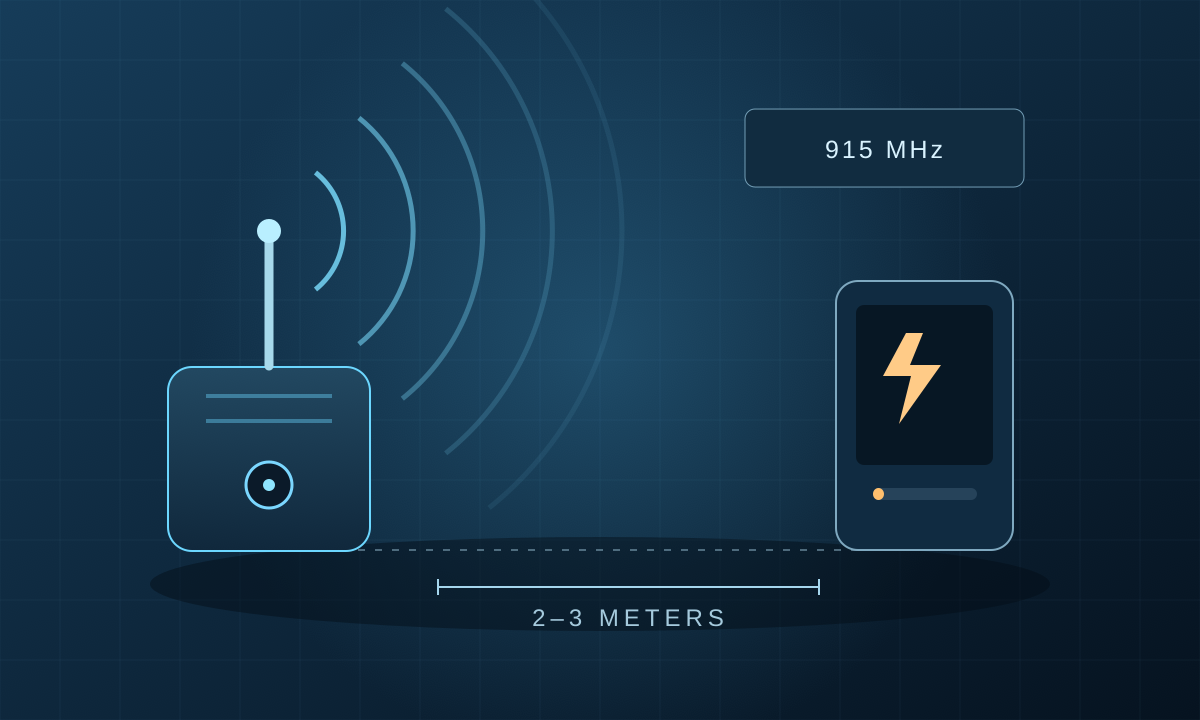
Do not proceed with the investment on the stated technical claims.
The claim
Wichargless advertises 200 mW of continuous DC power at both 2 and 3 meters. It submits a lower-power 4 W EIRP configuration for FCC testing rather than the transmit power needed to deliver that output.
Evidence basis
The case specification is a 915 MHz, free-space, far-field link with 0 dBi receiving-antenna gain, 50% RF-to-DC conversion, and a qualifying Part 15.247 transmission mode. The link budget gives 0.340 mW DC at 2 meters and 0.151 mW at 3 meters.
Finding
The claimed output is 588 times above the modeled result at 2 meters and 1,324 times above it at 3 meters. Reaching 200 mW with the same receiver would require approximately 2.35 kW and 5.30 kW EIRP, respectively. Approval of the submitted lower-power configuration does not validate that advertised performance.
What it means for the investor
The core performance promise fails under the stated specifications. The mismatch is sufficient for a no-go decision; another round of testing is not needed to reach that conclusion.
This conclusion is specific to the stated configuration. Approximately 4 W is not a universal FCC ceiling; other regulatory routes and architectures are different cases.
Technical references: NTIA Spectrum Management Technical Handbook · 47 CFR 15.247 · 47 CFR 18.305
02 / Software and AI diligence
AI Fraud Analysis Platform
The agents were custom. The model reasoning was not in-house.
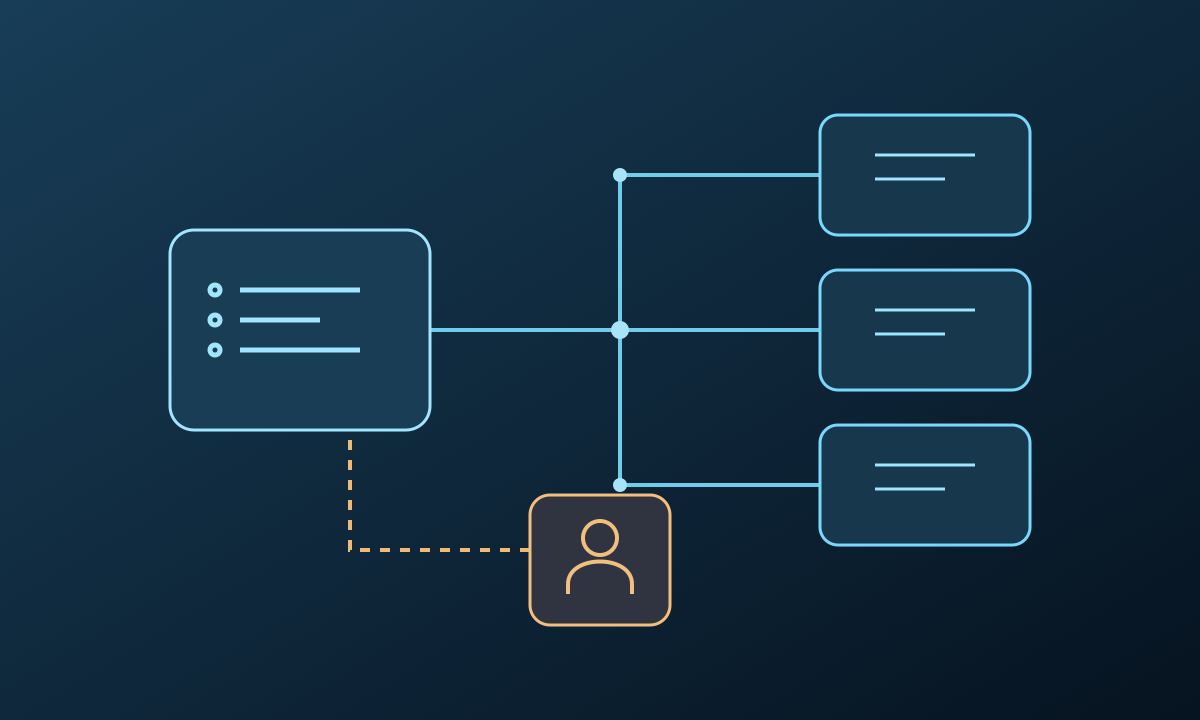
Do not proceed on the claimed all-in-house technology and minimal-human-input investment premise.
The investment claim
The platform is presented as an in-house fraud-analysis engine whose proprietary agents make decisions with minimal human input. The case's agreed acceptance gates require human adjudication on no more than 5% of test cases and automatic clearance of no more than 2% of known fraud cases. The valuation premise includes ownership of the core model technology.
What the implementation actually contains
Sample modules and configuration select off-the-shelf Anthropic Claude, OpenAI, and xAI Grok models. Executed request traces show transaction features sent to those providers for analysis. This conclusion comes from endpoints, model selections, and runtime calls, not SDK imports alone: the OpenAI SDK can also call xAI's endpoint.
The in-house code provides routing, prompts, business rules, and evidence aggregation. That software may be valuable proprietary work. It does not make the provider-trained models an in-house asset. The product audit log also omits prompt revisions and provider response identifiers, weakening decision traceability.
What the patent material establishes
The supplied claims recite case routing and aggregation; the description permits external model services. Those materials describe claimed subject matter, not proof of the deployed implementation, ownership of provider models, or fraud-detection performance. The runtime traces establish the implementation dependency. This is not a patent-validity or infringement finding.
The autonomy claim fails its acceptance gates
The controlled suite contains 200 labeled cases: 100 fraudulent and 100 legitimate. Eighty require human adjudication, a 40% review rate versus the 5% limit. Ten of the 100 known fraud cases are automatically cleared, a 10% escape rate versus the 2% limit. Deferred cases are counted separately, not credited as autonomous successes. These are results for this workflow and suite, not production-wide estimates or provider benchmarks.
What it means for the investor
Reject the investment case as presented. It overstates in-house ownership of the model layer and fails the agreed low-touch operating gates. External APIs alone are not the reason for the no-go, and they do not establish why the errors occurred. The decisive issues are the unsupported ownership premise and demonstrated acceptance-test failures. Any value in the orchestration layer must be assessed on that narrower basis.
Technical evidence & acceptance-test detail
Traced provider interfaces
Anthropic ClaudeAnthropic().messages.create(...)https://api.anthropic.com/v1/messages
OpenAIOpenAI().responses.create(...)https://api.openai.com/v1/responses
xAI GrokOpenAI(base_url="https://api.x.ai/v1").responses.create(...)https://api.x.ai/v1/responses
| Acceptance measure | Required | Observed | Outcome |
|---|---|---|---|
| Cases requiring human adjudication | ≤5% (at most 10/200) | 40% (80/200) | Fail |
| Known fraud automatically cleared | ≤2% (at most 2/100) | 10% (10/100) | Fail |
| System action | Known fraud | Legitimate | Total |
|---|---|---|---|
| Automatically block | 60 | 10 | 70 |
| Automatically clear | 10 | 40 | 50 |
| Require human adjudication | 30 | 50 | 80 |
| Total | 100 | 100 | 200 |
The balanced suite is an agreed acceptance test, not an estimate of production fraud prevalence. Manual outcomes are not folded into autonomous detection performance.
Reference sources for API interfaces and patent-claim principles: OpenAI Python API library · Anthropic Python SDK · Grok API quickstart · USPTO Applying for Patents · USPTO Managing a patent
03 / Software and scalability diligence
Software Platform Scalability Review
The current plan fits. Expansion needs a separate proof point.
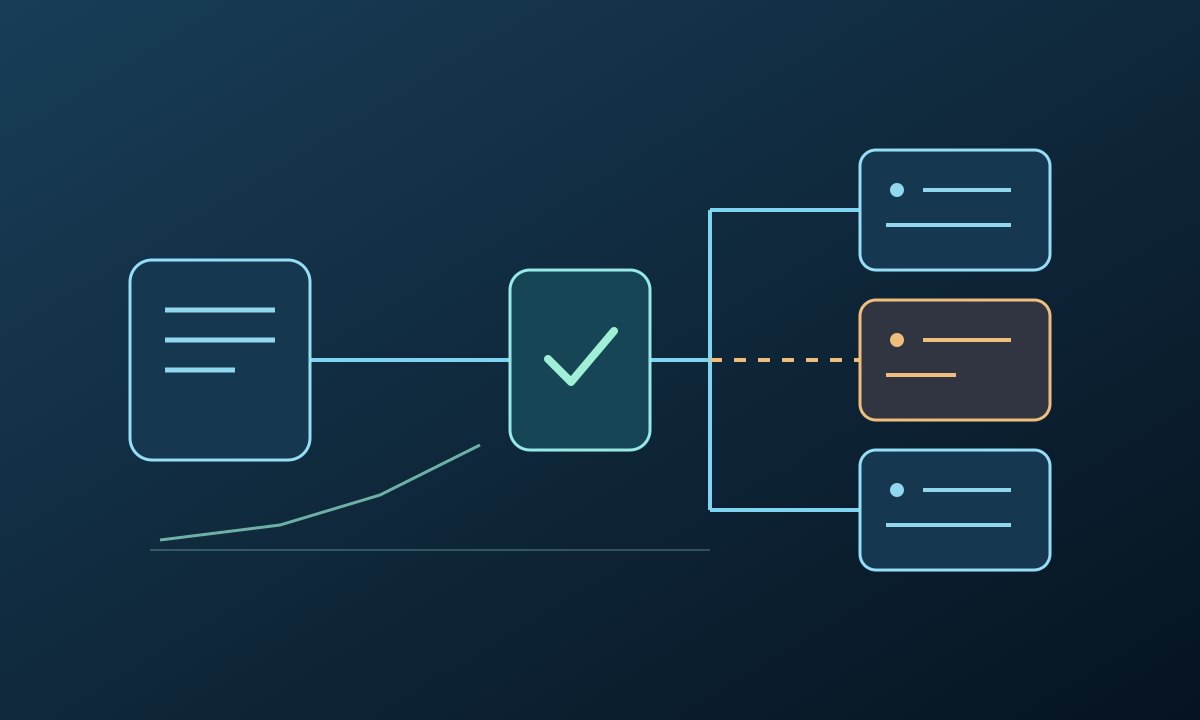
The current use case is supported within the tested envelope; commit expansion capital against a separate capacity gate.
The investment claim
The near-term operating plan requires 80 requests/second for a specified workload. A later expansion proposes 400. The diligence question is whether the platform supports the current investment case, and which growth assumptions should remain outside the base case.
What the bounded checks support
Functional checks of selected critical workflows and targeted authentication and authorization tests pass. These samples support the immediate use case; they are not full-product acceptance or a comprehensive security audit. Untested functionality, security controls, and production variability remain outside the conclusion.
What the load replay shows
A fixed, production-shaped request mix is replayed against staging hardware and database configuration matched to the intended deployment. Dataset, tenant distribution, and request mix remain constant. Each load step has a 10-minute warm-up followed by a 45-minute measurement window. At 150 requests/second, p95 response latency stays below 300 milliseconds and errors below 0.5%, meeting both acceptance thresholds. The error rate counts failed requests and timeouts across all attempted requests.
Where performance degrades
At 250 requests/second, p95 latency reaches approximately 800 milliseconds and errors reach 1.8%. Traces show database connection-pool waits alongside slow reporting queries. Their concurrence identifies a bottleneck hypothesis, not an isolated cause. The 400-request/second expansion target has not been validated.
What it means for the investor
Proceed with the current use case. Set an initial rollout budget of 100 requests/second, one-third below the demonstrated passing level, and monitor latency and errors against the tested thresholds. Treat this as an operating guardrail, not a production capacity guarantee. Keep expansion funding separate: release it against a tuned design sustaining 400 requests/second under representative conditions and the same acceptance thresholds. This gate applies to the expansion, not the current investment. Application autoscaling alone is not assumed to resolve database contention.
Load-replay results & operating guardrails
| Workload level | p95 response latency | Error rate | Interpretation |
|---|---|---|---|
| 80 requests/second | Not separately reported | Not separately reported | Near-term requirement for the specified workload |
| 150 requests/second | <300 ms | <0.5% | Passes both acceptance thresholds |
| 250 requests/second | Approximately 800 ms | 1.8% | Fails both acceptance thresholds |
| 400 requests/second | Not tested | Not tested | Expansion target; unvalidated |
The 100 requests/second initial rollout budget is an operational guardrail, not an additional test result. The results cover the specified mix, dataset, configuration, and measurement windows; they are not a long-duration production guarantee.