

AthelGuard Editorial · Latest Insights
A supplier can look reassuring on a checklist while leaving one important question unanswered: what happens to your business when its service fails?
On October 22, 2026, NIST published the initial public draft of SP 800-221 Revision 1. It proposes integrating information and communications technology risks into enterprise risk management, describing consequences in financial, mission and reputational terms. Comments are due December 7, 2026. This is a draft, not a final publication.
Our Take: Make the Claim Answer a Decision
For a founder or buyer, a useful first step is to turn one vendor assurance into a short, testable business scenario. A general label such as “low risk” hides too much unless the reader knows the workflow, assumptions and evidence behind it.
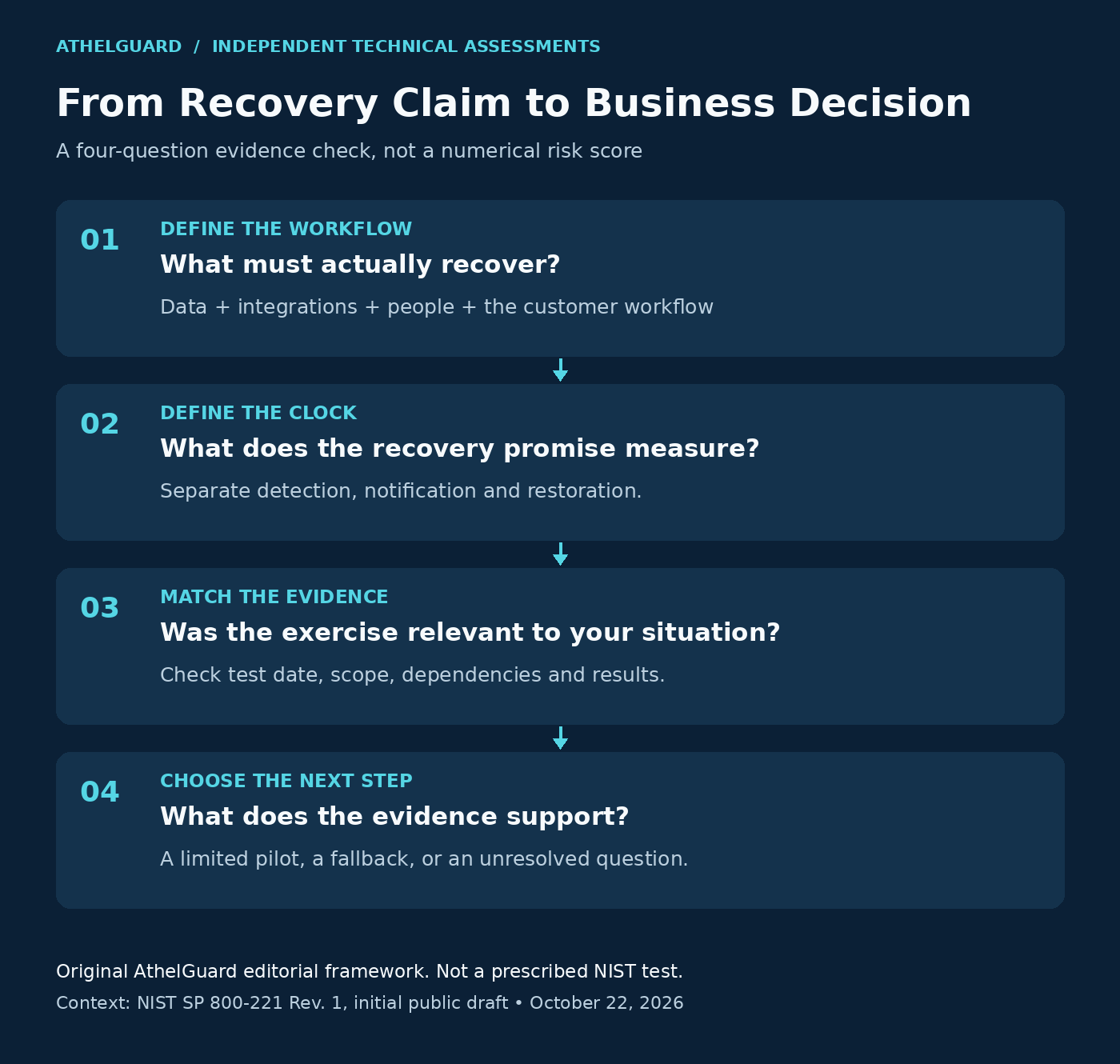
Consider a hypothetical supplier that says it can restore service within four hours. Before relying on that statement, ask:
- What must recover? Identify the actual workflow, including data, integrations and the people needed to resume operations. A running server alone may not restore order processing.
- When does the clock start? Detection, notification and restoration are different milestones. Ask which interval the claim covers and what the customer must do.
- What evidence matches our situation? Request the date, scope and result of a relevant recovery exercise. A demonstration using a small clean dataset may leave production dependencies untested.
- What decision follows? State whether the evidence supports a limited pilot, requires a fallback or leaves a critical question unresolved. Name an owner for that next step.
Keep Uncertainty Visible
Use a range for the potential interruption and record its assumptions. Do not turn missing information into a confident score. A one-page scenario with a clearly identified evidence gap can be more useful than a polished rating that cannot explain what would change it.
This checklist is AthelGuard’s practical interpretation, not a prescribed NIST test or a finding about any named supplier. It illustrates the purpose of Independent Technical Assessments: connect a specific claim, supporting evidence and remaining uncertainty to a decision the reader actually needs to make.

Related Posts

When AI Coding Outruns the Repository

A Patch Release Is Not Proof of Deployment