
An AI product can work well and still depend on computing capacity its operator cannot reliably keep. The reported Oracle–Tencent deal cancellation makes that distinction worth examining: model capability and continued access to infrastructure are separate questions.
What has been reported, and what remains unconfirmed
On November 4, 2026, Reuters reported that the Financial Times, citing people familiar with the matter, said Oracle had abandoned an AI chip-leasing deal with Tencent following pressure from the Trump administration. Reuters said it could not immediately verify the report. Oracle, Tencent and the White House had not responded to Reuters’ requests for comment at publication.
Reuters also described the FT’s earlier account of the proposed arrangement: roughly $7 billion, about 100,000 advanced AI chips and a five-year lease across Oracle data centers in Southeast Asia. Those figures and the reported cancellation are attributed reporting, not independently established findings by Athelguard. Read the Reuters report, syndicated by Investing.com.
We have not assessed either company or reviewed the proposed contract. The practical question below does not depend on assuming that every reported detail is confirmed.
A second region is not always a second route to service
Disaster recovery commonly addresses a failed region or unavailable infrastructure. Oracle’s own Cloud Adoption Framework guidance calls for recovery objectives, suitable standby resources and consideration of capacity reservations. A backup copy alone is not a working application.
Our analysis adds a separate scenario: what if access to the provider or a particular class of accelerator changes? Moving between two regions of the same provider may help with a regional outage. It does not necessarily create an independent fallback for a provider-wide access restriction. The failure scenario must match the recovery design.
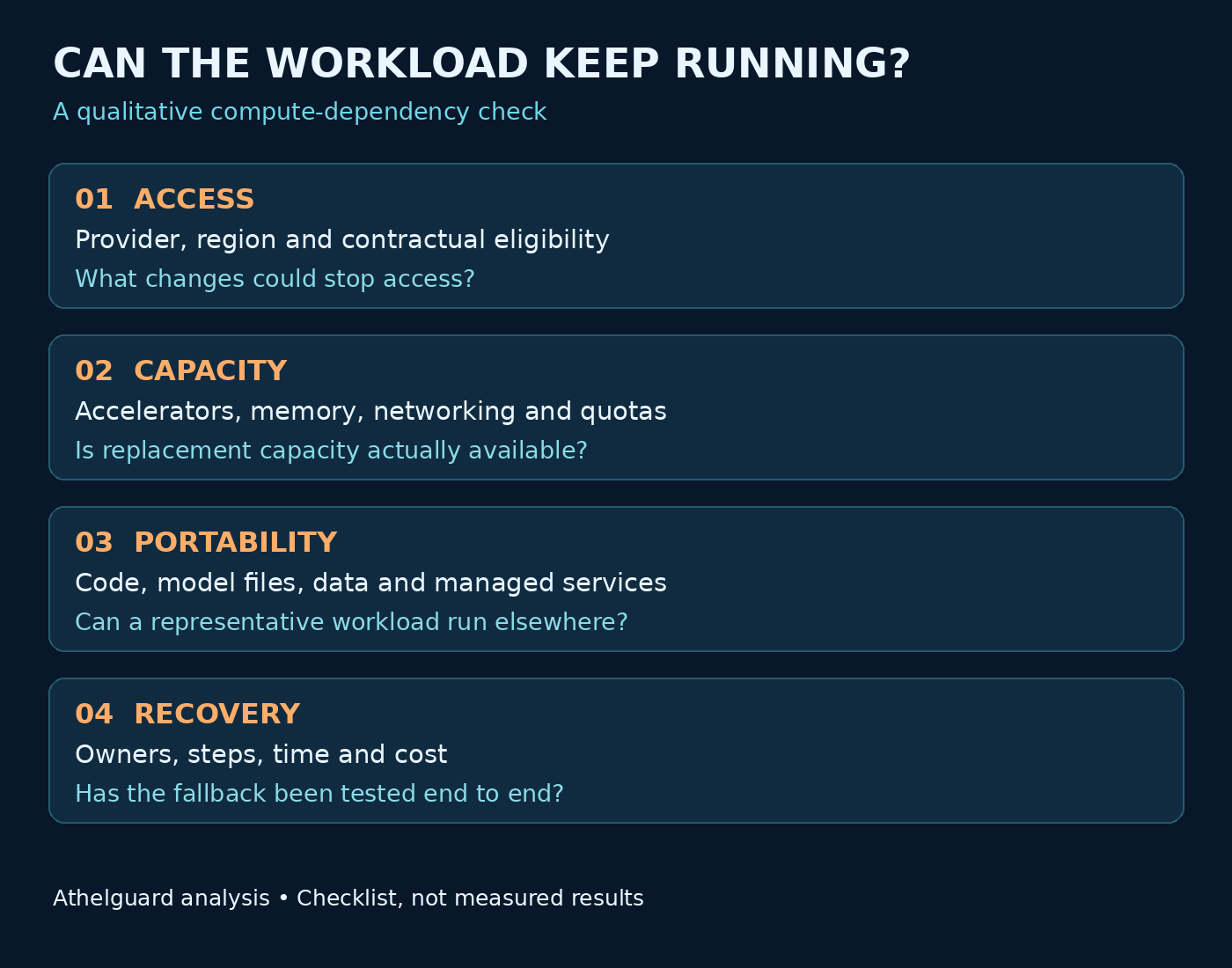
The takeaway: passing one check does not pass the others. Portable code can still lack available hardware. Reserved hardware can still require a costly migration. A written plan can still fail in execution.
Four evidence requests before relying on an AI deployment
1. Map the access dependency. Identify the provider, region, account owner, service and accelerator type behind the workload. Ask which contractual or eligibility conditions affect access and who monitors changes. Technical reviewers can document dependencies; qualified legal advisers should interpret applicable contractual and regulatory obligations.
2. Verify replacement capacity. Ask what “we can move” actually means. Is alternative capacity reserved, contracted, quoted or merely listed in a catalog? Record memory, networking, storage and quota requirements, not only chip count. A comparable accelerator count does not establish comparable workload performance.
3. Demonstrate portability. Request a representative workload running on the proposed fallback. Check model-file rights, data export, framework compatibility, managed-service dependencies and security controls. Record which steps remain manual and which components need replacement. Distinguish the ability to restore an inference service from the ability to resume a large training job.
4. Measure recovery and cost. Agree how long the business can tolerate interruption and how much data loss is acceptable. Then rehearse the transfer, configuration and validation steps. Compare observed time with the target, and include idle capacity, data movement, engineering work and changed operating costs in the estimate.
Start with a bounded test, not a blanket multicloud mandate
A smaller business may not need two full production environments. It may need a tested reduced-capacity mode, a delayed-processing option or a documented way to suspend a noncritical feature safely. The appropriate fallback depends on customer commitments and the cost of interruption.
A useful first exercise is to select one critical workflow, define its minimum acceptable service level and test the proposed alternative end to end. Keep the results, unresolved dependencies and decision owner together. Do not describe an untested migration plan as verified resilience.
For businesses and investors, the central assessment question is straightforward: what evidence shows that this product can keep delivering its essential service if its current compute arrangement changes?
Athelguard provides Independent Technical Assessments. To discuss a focused technology or dependency question, visit Assessments. This article is educational analysis, not a completed assessment of the named companies, legal advice or an investment recommendation.
Sources reviewed November 5, 2026: Reuters reporting dated November 4, 2026, syndicated by Investing.com; Oracle Cloud Adoption Framework, disaster-recovery guidance. Reporting status is stated as of those sources.

Related Posts

Assess Small Suppliers by Exposure, Not Headcount

What Evidence Supports a Technology Claim?