

AthelGuard Editorial
A masked value in a monitoring dashboard tells you what the viewer displays. Establishing what the underlying system stores requires a different check.
In its November 4 disclosure, Kernel reported that an unauthorized party accessed its logging provider and downloaded data containing some API keys and third-party secrets. That account provides a timely reason to examine how sensitive values travel through operational tooling.
OWASP’s Logging Cheat Sheet identifies access tokens, passwords and primary secrets as data that should usually not be recorded directly. It also recommends testing logging behavior and verifying access controls. The practical assessment question is where those protections take effect.
Follow a Harmless Marker
In an authorized test environment, place a unique, inert marker in a representative field that could carry a secret: a request header, payload or error message. For pattern-based rules, use inert fixtures matching the documented formats. Never deliberately log a real credential.
Trace the event through application output, local logs and traces, collectors, stored records, search results and exports. Include relevant error paths and debug settings. Record where the marker appears, where it is removed and which destinations remain untested.
Locate the Redaction Boundary
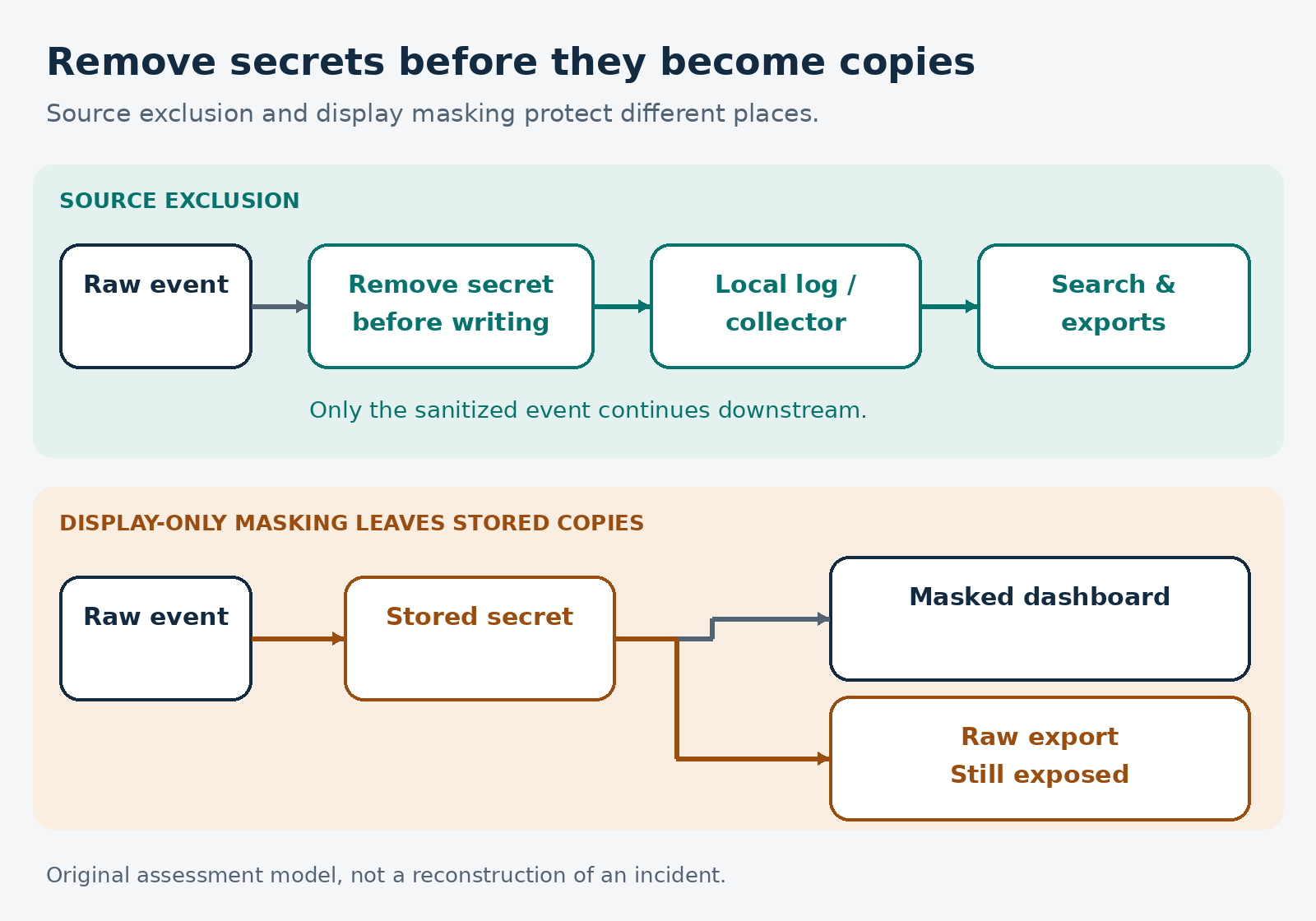
If the dashboard hides the marker but a raw export contains it, the protection is at the display layer. Earlier storage and transmission still need examination.
For fields that should never enter telemetry, test exclusion before the first log or trace write and before onward transmission. Check separate instrumentation paths: an application logger and an error-reporting SDK may collect different information. Retain safe event context, such as a correlation identifier and outcome, to support investigation.
Test Revocation Separately
Use a deliberately scoped test credential in an isolated workflow to verify revocation, without inserting it into logs. Check which sessions or dependent credentials require separate action. Rotating one key does not establish that every related access path has closed.
If actual secrets are discovered in historical logs, coordinate containment and evidence preservation before changing retention or deleting records.
Ask for Scoped Evidence
For founders and investors reviewing a technical business, useful evidence includes the tested route, configuration, sanitized results, access boundaries and unresolved exceptions.
Athelguard’s Independent Technical Assessments can examine those records and reproduce agreed checks. The conclusion should state what was demonstrated, when and within which scope. A clean sample supports that finding; it does not prove that the entire logging estate is free of secrets.

Related Posts

Size Local AI for the Working Context

Compare Copilot Code Reviews on the Same Basis